
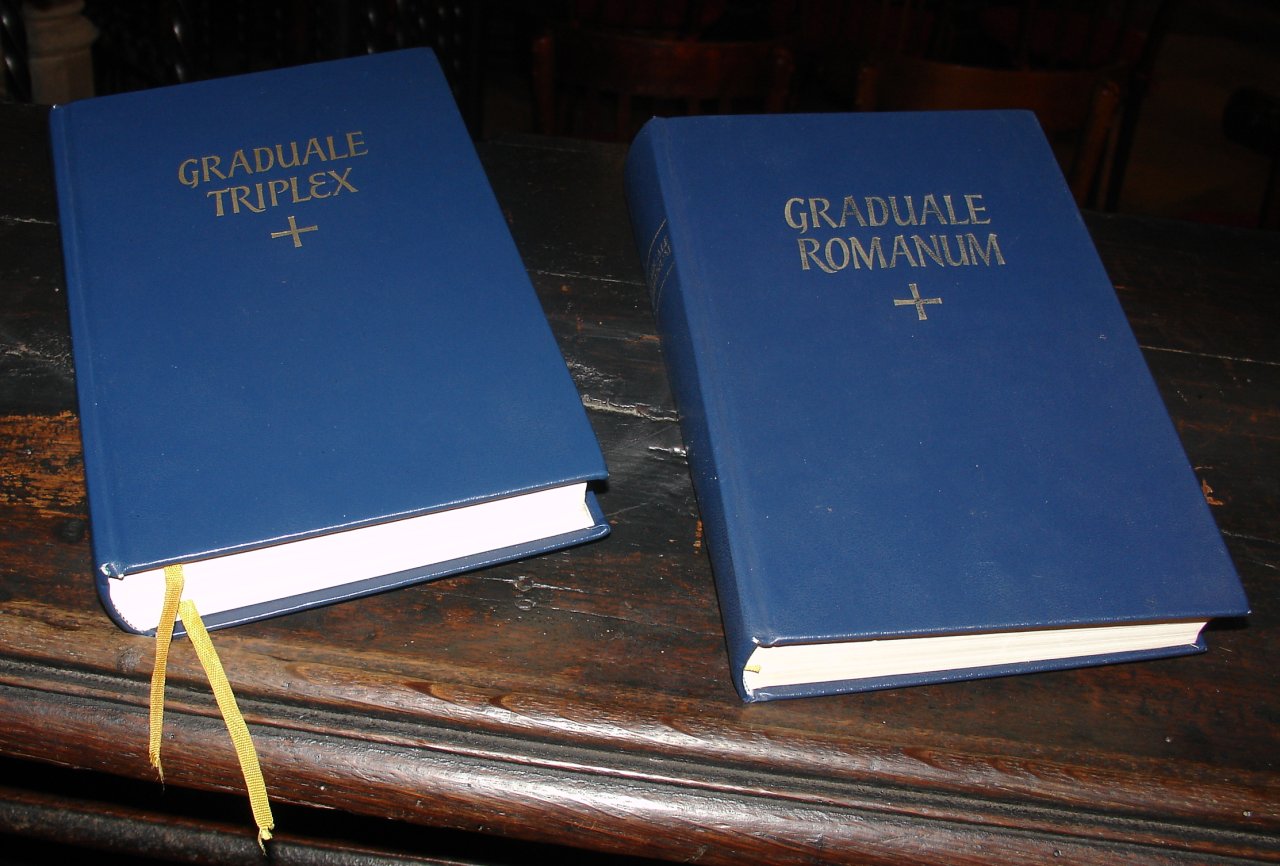
A must of an Gregorian schola is a so called gradual, a book collecting all musical items of the Mass for the whole liturgical year. It contains chants for ordinary (invariable parts of the mass like Kyrie, Gloria, Credo…) and for proper (parts of the mass that varies like Introit, Gradual, Alleluia, Offertory, Communion…). Apart from texts of these chants it contains of course the melody of it in quadratic notation.
The official gradual of Roman Catholic Church is currently Graduale Romanum (GR) published in 1974. Graduale Triplex (GT)(1979) is actually Graduale Romanum supplemented with two neumatic notations. Above the quadratic record there is black transcription of Laon neumatic manuscript and beow the system is red neumatic record of St. Gallen family of manuscripts. The majority of proper is notated in this manner. This is where its name comes from.
Here you can see samples from the same site in GR and GT. (Click to the picture to see the whole image in bigger size)


Publishing of GT was inspired by “Graduel neumé”, by Dom Eugène Cardine. After the release of GR in 1974, two members of AISCGRE disposed to transcribe neumatic manuscripts into this Gradual: Marie-Claire Billecocq (Veniere, France) on the neums of the Laon manuscript (in black) and Rupert Fischer (Metten, Bavaria) on the neums of the manuscripts of the Saint-gall family (in red).
The following manuscripts have been used (mainly the first three of them):
| L | Laon, Bibl. Munic. 239 | after 930 | PM X |
| C | St. Gallen, Stiftsbibl. 359 | end of the IXth century | PM deuxieme serie, II |
| E | Einsiedeln, Stiftsbibl. 121 | beginning of the XIth century | PM IV |
| G | St. Gallen, Stiftsbibl. 339 | first half of the XIth century | PM I |
| SG | St. Gallen, Stiftsbibl. 376 | XIth century | |
| H | St. Gallen Stiftsbibl. 390/391 | between 996 and 1011 | PM deuxieme serie, I |
| B | Bamberg, Staatsbibl. lit. 6 | third third of the Xth century |
At the beginning of each piece of chant there are given the sigla of the manuscripts from which the neums have been drawn, together with an indication of the page and folio number. In addition the sigla of the oldest Antiphonaries of the Mass without notation, which contain the pieces under consideration have been added; this data has been taken from the “Antiphonale Missarum Sextuplex” (Dom René-Jean Hesbert):
| M | Cantatorium of Monza | second third of the IXth century |
| R | Graduale of Rheinau | about 800 |
| B | Graduale of Mont-Blandin | VIII-IXth century |
| C | Graduale of Compiegne | second half of the IXth century |
| K | Graduale of Corbie | after 853 |
| S | Graduale of Senlis | between 877 and 882 |
For example you can see in the picture from GT that the introit “Omnes gentes plaudite manibus” occurs in all the named manuscripts (RBCKS) except for Cantatorium of Monza. The above notation is taken from Laon 239, folio 152 (L152) and the red one under the text is from Einsiedeln 121, folio 319 (E319).
You can buy GR and GT by the publisher – Benedictine abbey in Solesmes.
You may have already learned from our Article, that the copy of 1961 GR is available online. The most important difference between it and the current GR is the order of chants. We can simply use index of GR 1974 and substitute it in this manner. But we will probably not find GT online for a long while. We could try to transcribe neums from one of St. Gallen manuscripts – it is not simple work, I could confirm it. As you will read later on, there is one more possibility.
AISCGRE works diligently on the restitution of GR chants. The goal of this process is to apply the new results of the research of old manuscripts. The result should be a chant book, which would be (by its content) as close as possible to chant praxis in the gold era of chant (approx. 9th century). Some of the results publish AISCGRE in its magazine “Beiträge zur Gregorianik“. Thanks to Mr. Anton Stingl Jr. we can find these results also available online.
In booklets, published continuously on his website Gregor und Taube there are chants for particular celebrations in quadratic notation (modified in accordance with BZG) along with st. Gallen neumatic notation above the line. So, if you don’t mind the difference to GR melodic version of chants, these booklets are the ideal solution for chant schola. Already today there are files for almost every sunday of liturgical year. One more advantage over GR/GT is the fact, that there are no ictuses – deprecated “feature” of GR and GT.

Ictus – the vertical rhytmical sign
The theory of ictuses was introduced by Dom Mocquereau from the Abbey of Solesmes firstly in GR 1908, and it was used by hundreds of thousands of people in the whole world. This theory was disproved by his later colleague in Solesmes – Dom Cardine – who with his work “Gregorian Semiology” (1968) is indelible written in the history of restoration of Gregorian chant. But still today scholars meet ictuses on almost every step.
Despite the big progress in the research (or maybe that’s why), publishing of new gradual is not near. Some of the problems connected with it have been analysed by Dom Daniel Saulnier in his article published in BZG.
The performance of Gregorian chant with the use of Semiology really seems to be the right way. Therefore, if you think about buying GR or GT I absolutely recommend GT. Its price is a bit higher than the price of GR, but the value is almost 3 times higher. The next step would be to learn to understand these mysterious signs. We might discuss this topic in future.
Used abbreviation:
- GR – Graduale Romanum
- GT – Graduale Triplex
- AISCGRE – Associazione Internazionale Studi di Canto Gregoriano
- PM – Paleographie Musicale
- BZG – Beiträge zur Gregorianik
Sources:
- Graduale Romanum. Solesmes : Abbaye Saint-Pierre de Solesmes, 1974. 918 s. ISBN 2-85274-094-X.
- Graduale Triplex. Solesmes : Abbaye Saint-Pierre de Solesmes 1979. 918 s. ISBN 2-85274-044-3.
- Associazione Internazionale Studi di Canto Gregoriano
- www.gregor-und-taube.de/html/materialien.htm
- Gregorian Chant – Plainchant – Gregoriaans
Read about our Graduale Project:

Nemáte prosím nejaké slovenske vydavatelstvo,kde sa dá Graduale Romanum kúpit??
Žiaľ, neviem o žiadnej možnosti zakúpiť GT, alebo GR na Slovensku. Ak máte problém nakupovať cez internet, môžme sa zkontaktovať, možno to spolu vyriešime.
The English version has been corrected with help of Linda Popa. Thanks Linda 😉
Dom Cardine nie je autorom Gregoriánskej semiológie.
Žiaľ, vôbec ste nepochopili význam diela Dom Mocquereaua.
Ktorý variant je „vedeckejší“ – Graduale Novum, Liber Gradualis, alebo niektorý iný?
Ktorý autor najlepšie “zreštituoval“ spevy – Godehard Joppich, Anton Stingl, Alberto Turco, alebo niekto iný?
Aby nedošlo k nedorozumeniu, pokúsil som sa moje predchádzajúce stručné poznámky trocha rozšíriť:
Anglické vydanie Gregorian semiology je z r. 1982. Prvé vydanie tohto diela ale bolo v taliančine, až potom nasledoval preklad do francúzštiny a angličtiny. Hlavnými autormi sú žiaci E. Cardina – G. Joppich a R. Fischer, ktorí pri práci na knihe vychádzali (ako som sa kdesi dočítal) z Cardinových prednášok. V uvedenom anglickom vydaní sú na samom začiatku uvedené nasledujúce slová E. Cardina:
„It is my pleasure to express gratitude to Dom Godehard Joppich who first conceived this publication and who is entirely responsible for the first edition in Italian.“
Píšete: „Zároveň v tomto prípade odpadá jedna z vád GR i GT — ikty. Teóriu iktov zaviedol Dom Mocquereau z kláštora v Solesmes prvýkrát v GR v roku 1908 a rozšírila sa, žiaľ, do celého sveta.“ Nejde o „vadu“ a rozšírila sa „našťastie“, a nie „žiaľ“. Značenie iktov má dodnes význam hlavne pre amatérskych spevákov. V anglickom vydaní Mocquereauovej knihy Le Nombre Musical Grégorien z r. 1989 sa píše: „…book will …remain …forever worthy of being re-edited in order to remain available to Gregorian chant scholars… …[there are] numerous studies illustrating how fruitful the intuitions of these pioneers [A. Mocquereau a J. Pothier] were…“
Okrem Mocquereauvho diela z oblasti paleografie patrí jeho chápanie voľného rytmu gregoriánskeho chorálu k podstate jeho diela. To nie je len nejaká „teória iktov“. Pokiaľ ide o samotné ikty, Mocquereau v závere Le Nombre Musical Grégorien píše:
„570. — The student should begin by giving the ictus a delicate shade of emphasis that can be heard. It will serve to sustain the voice as it passes from note to note. Gradually he should diminish the force of the ictus until, finally, it disappears materially, remaining merely a mental support, an intuition, a feeling for form. By following this process the singer will attain complete control of his voice and will use one or the other of these ways of treating the ictus according to the norms of good taste, of art and the laws of expression.“
K čomu vedie nechápanie tohto, možno ľahko zistiť na YouTube – vyrojili sa nám speváci-bastardi. (Výraz „bastard“ použil aj Mocquereau, a to pri kritike tých, čo chceli meniť melódie starých rukopisov bez dostatočného zdôvodnenia, len na základe vlastnej chuti a ľubovôle.)
A teraz sa dostávame k jadru veci. Píšete: „Ak vám teda neprekáža, že jednotlivé spevy sa miestami odlišujú od toho, čo poznáte z GR, zošitky pána Stingla sú ideálnym riešením pre chorálnu scholu. Už dnes zverejnené súbory pokrývajú takmer všetky nedele liturgického roka.“
Ak máte na mysli koncerty „chorálnej scholy“, nie je potrebné to komentovať. Ak ale navrhujete takto spievať v rámci liturgie, odporúčam počkať na oficiálne „motu proprio“ z Vatikánu. Myslím si, že nie je vhodné, ani správne odporúčať spievať počas liturgie z neoficiálnej (študijnej) verzie. V zásadných záležitostiach má byť v Cirkvi jednota a liturgia je pre Cirkev zásadná záležitosť.
Vďaka za komentár a za jeho rozšírenie.
V žiadnom prípade nechcem vzbudiť dojem, že Dom Mocquereau nemá zásluhy na novodobých pokrokoch v štúdiu gregoriánskeho chorálu. Bez jeho práce a práce jeho predchodcov a kolegov by ani Dom Cardine nemal na čom stavať. Ikty napriek tomu nepovažujem za nápomocné, ani pre začínajúcich spevákov.
Argument melodickej jednoty gregoriánskeho spevu pri liturgii mi je sympatický – v našej liturgickej praxi tiež používame štandardné nápevy – aj keď melodická rôznorodosť určite nejde proti liturgickým predpisom.
O semiologickej metóde interpretácie:
“Most of what the semiology says seems to be towards an opening up of the text, in other words a description and explanation of the text through music. Semiology has to be seen as an aid, not an end in itself. If it becomes an end in itself, problems can arise. If you try and sing everything marked in the semiology you will end up tying yourself in knots and the result will probably be stiff rather than flowing. The singer must never feel a victim of a system and the chant must seem natural.” Charles Cole
Sacred Music Volume 139, Number 3, str. 23 (Fall 2012)
(Charles Cole is Director of the London Oratory Junior Choir and the Schola Cantorum of the London Oratory School.)
Súhlasím s týmto pánom… akákoľvek notácia musí byť len pomôckou a spev musí znieť prirodzene a neviazane…
Bonjour
Est-il toujours possible d’acheter vos enregistrements du Graduel ?
Is it possible to buy your graduale recordings ?
I like very much what you do
God bless you
bertrand thillaye du boullay
St Germain en laye Yvelines
France
+ 33 6 5160 2378
Thank you! Yes, the recordings are available on several places:
iTunes
CD baby
Google play
…